
Between White and Black. Yohaku (余白). Organic Movement Born from Not Defining Things Strictly.
Updated: Jul 22
An annual family camp in a place where there is absolutely no phone signal. My daughter is now a Year 12 student, so I spent the 4 days of off-grid life feeling a little sad and deeply moved, thinking this might be the last time she comes along with us like this.
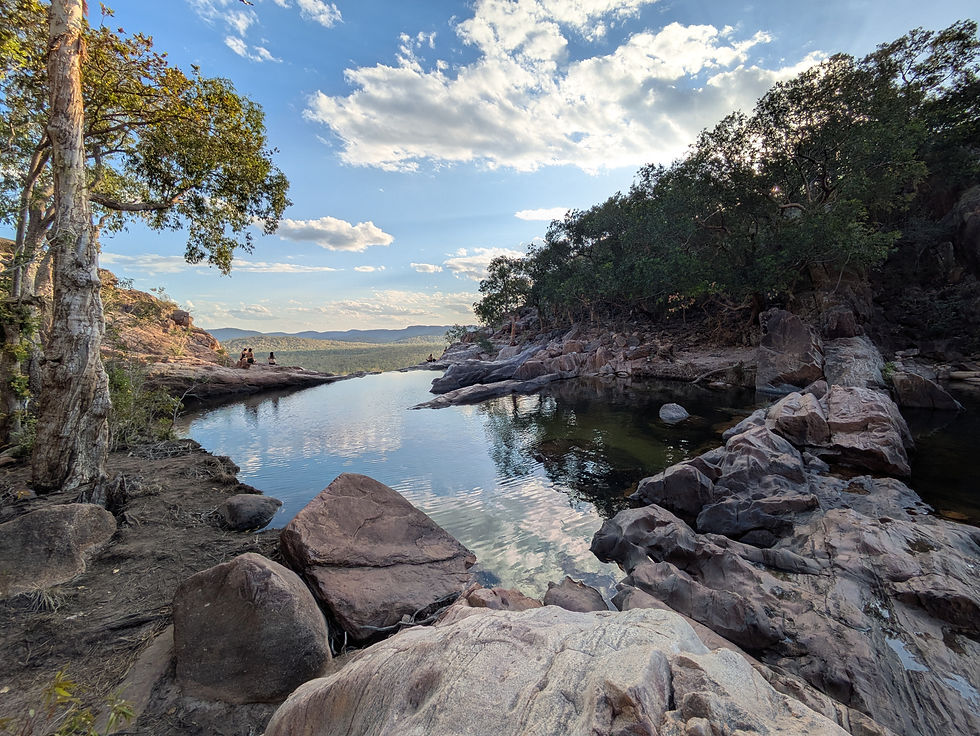
There was no being rushed by smartphone notification sounds, and no being distracted by things happening on the other side of the screen. By putting myself in an environment with "no signal", I left the world of all artificial digital connections, and instead, I felt my own senses being unlocked. This time, I want to write down what I saw and felt through my skin exactly because there was no signal.
The Ambiguous Road of Nature Where Textbook "White and Black" Does Not Work
During this trip, my daughter with her P-plates took the steering wheel of the 4WD on an unsealed mountain road. I was watching over her quietly from the back seat, and right there was a continuous organic process between "knowledge" and "practice", which means "living learning".
"For a rough road of this level, a 4WD diff lock is not necessary."
"On sandy ground, let the air pressure out of the tyres to increase grip and widen the contact area."
This kind of knowledge is, so to speak, a "clear-cut white and black correct answer" which can be seen in a manual. However, the actual road in nature is not that simple.
The shadows cast by the sunlight filtering through trees hide the bumps on the road surface, and the boundary of where is safe and where is not is always ambiguous. A linear rule of "if you do this, that happens" does not work. It is necessary to continually fine-tune how to turn the steering wheel and press the accelerator, while feeling the grip of the tyres and the shaking of the car body in that exact moment.
While watching my daughter's driving as she moved in a zigzag to avoid small rocks, I felt the importance of moving forward with open senses. It is not about judging whether something is "correct (white)" or "incorrect (black)", but feeling our way through the ambiguous area in "between". Making clear-cut white and black knowledge drop into the gut (Haraochi, 肚落ち) one by one, through the organic movement of endless fine-tuning. I witnessed that process right in front of my eyes.
The Power of Making Things Clear-Cut, and What Gets Scraped Away
And another thing that stayed in my mind was the simple and yet organic communal life in the mountains.
Unlike everyday life where we progress plans in small steps according to the hands of a clock, "the position of the sun" was a more important standard of action in nature. While the sun is out, we comfortably proceed with setting up the tent, preparing dinner, collecting dead wood for the campfire, and drawing water for washing dishes.
What was interesting here was that there was no clear delegation of roles as to "who does what". A person whose hands became free after finishing one task voluntarily started the next job. Exactly because we did not drift off to smartphone screens, everyone's body and mind were both "here". We were moving our own hands while always keeping people doing other tasks somewhere in our sight, feeling each other's presence (Kehai, 気配).
Looking back on everyday life on the other hand, we might be placing too much emphasis on making things "clear-cut white and black".
Of course, when we set a purpose clearly in a team, clarify each person's roles, and make a plan, a tremendous power to push forward towards the purpose may be generated. The clearer the purpose and goal are, the more that power is converted into great energy.
However, no matter how precisely we divide roles and make a plan, there always exist "things left behind", "things scraped away", and "things out of plan". The more we are moving in a straight line with a clear direction, the more we become unable to notice those things falling through the cracks and the changes in our surroundings.
The "Yohaku" Born From the Undefined
When we seek efficiency and results, we assign tasks neatly without gaps like puzzle pieces, designing it so as not to leave any Yohaku (empty space) there. And a "division of roles" that is too clear sometimes leads to "division of people". The moment work is carved up, it leaves our own hands and becomes "someone else's business", making it harder for us to care for the person taking on that task, especially when we don't see them. Because we cannot even feel the presence of the other person, if things do not progress at our assumed pace, it is so easy for us to make one-sided evaluations like "slow" or "inefficient".
On the other hand, like this camp, a rich Yohaku existed where there was no clear delegation of roles (no clear-cut white and black).
When we do not assign clear roles to a person, a Yohaku is born for us to become aware of our surroundings and to think about offering a helping hand. We do not pack the schedule tightly, and a Yohaku comes along to "watch over someone's unfamiliar task from the side and wait".
This open space called Yohaku is like an invitation to Kizuki (realisation). Because it is there, room to pause is born, and there we can sense each other's presence, look around the whole, imagine what is calling next, and move spontaneously. Rather than being instructed by someone or forced into a role, we sense the atmosphere of the whole and become involved in that space gently by our own will.
Come to think of it, in Japan, we have been surrounded by these Yohaku-like things in our daily lives and culture since ancient times. The ambiguity of not making things clear-cut white and black, or the way of feeling each other's presence without putting it into words. In modern efficiency-focused society, it is sometimes perceived as frustrating, but originally, it might have been a very rich and highly advanced system for each person to be autonomous while moving in harmony as a whole.
Moving together, feeling the presence, proceeding at each person's pace, and respecting that mutually. Doing each single thing with care and love from the heart, opening our senses. Instead of dividing and disconnecting, keeping them in our thoughts even when we entrust tasks, sharing rich Yohaku, while each remains autonomous yet organically connected as a whole—. These were four days where the importance of such things was warmly absorbed into my body and soul.
Every world is up to our mindset and action.
Indeed, what kind of world we create is, in the end, up to our daily mindset and action like this.


