
Case Study: Fostering Collective Impact at Menzies School of Health Research
On 24 Feb 2026, a Possible World workshop was held for Menzies School of Health Research. Participants included members of the Menzies Education Team, who teach postgraduate public health and health research programs, along with colleagues from the Menzies - Ramaciotti Centre which supports young people into education and training pathways from school through to employment in the Northern Territory health workforce.
With staff located across multiple sites and coming from diverse professional backgrounds, the session focused on connecting each person's expertise with the collective impact needed to discover enduring solutions to critical health challenges. To support inclusion and participation, the workshop was delivered in a hybrid format, allowing some participants to join remotely.
Bridging "Knowing" and "Practicing"
In this session, the primary focus was placed on bridging the gap between "knowing in the head" and "embodying wisdom through the senses". Through the engaging Possible World simulation, participants were invited to access their inner senses—head, heart, and hara (gut)—and deeply observe their own mindsets in real-time. By stepping away from the daily routine and immersing themselves in a shared objective, the team had a rare opportunity to reflect on how individual actions ripple out to affect the whole system.
The Workshop Experience and a Shift in Perspective
The day unfolded through key experiential processes, beginning with a toothpick challenge that allowed participants to experience how elevating perspective opens unseen possibilities. Following this, participants intuitively measured where their current team stands against an ideal 10.
During the world creation simulation using the 2030 SDGs Game card kit, participants executed projects using time and financial resources, observing the "World Condition Meter". We had 8 teams, and two of them were hybrid teams connecting with their mobile phone or laptop to maintain communication for decision-making.

An initial candid reflection highlighted a challenge of a holistic view:
We did not pay attention to other teams. If we had known, we could have helped more.
However, as the activity progressed, a clear shift occurred from focusing solely on individual team goals to embracing the collective goal. A participant's gentle question regarding what a goal card was truly meant to achieve became a catalyst, prompting others to reconsider what actions were necessary for the whole. When Part 2 concluded, a natural applause arose in the room, reflecting a gentle yet deep sense of collective accomplishment.


Cultivating Team Harmony and a Shared Starting Line
The mapping data reveals significant positive shifts in how the team perceives its current state. At the beginning, the evaluation was broadly spread from 3.0 to 9.5, showing a polarising tendency. By the end, the dispersion became smaller, converging to a range of 4.5 to 9.0, indicating growing alignment. The average score elevated from approximately 6.7 to 7.2.
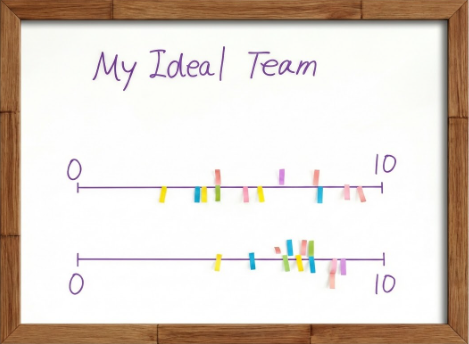
By sharing the team's strengths, members holding a negative perception were able to discover positive aspects of the team. As everyone was sharing a smile at the end of the session, the current state signifies a robust foundation has been cultivated. Everyone is facing the same direction, ready to proceed cooperatively.
Future Possibilities for Hybrid Teams
To transcend the boundary between in-person and remote participants and further deepen the spirit of co-creation, some possibilities emerged. These include an "Online Possible World for Everyone," where a profound sense of unity will be born, or a simultaneous "Two Worlds" approach intersecting diverse perspectives.
Anything is possible.


